Wednesday, 19 October 2022

Fund Launched!

 I've finally launched my global equity fund. Going around asking for friends and clients for commitment. It's a test of true friendship and those who helped me when I need it, I'll be indebted. 

For a start, I'm not truly convinced that we have seen the bottom. There's QT to contend with, plus earnings downward revision. 

I calculated that S&P500's fair value is between 3050 to 3600. A 20% earnings decline means 3050. No earnings increase over 2022 means 3600. We are approximately at fair value at the moment. 


For a start, the fund will be 25% invested into quality stocks. The balance will be used to sell cash secured puts to generate income. 


Stay tuned. I expect around 8 - 16% return in the next 12 months. 


Tuesday, 5 July 2022

Starting a Fund Soon

 Recently, I've been having a lot of pain dealing with a Prime Broker to open a fund. A prime broker is a platform that executes your trades, does administrative things like NAV calculation. I was asked to provide my CV which I thought I was well qualified for. But the Prime Broker appeared to be reluctant. I'm a bit frustrated and shall look for other prime brokers.

Moving on to stocks. I'm not as bearish as before. Inflation appears to be peaking in the US. I believe the S&P500 could bottom by August 2022. Let's not be too bearish. Focus on companies with good fundamentals and we will make many x from here. I'm looking at maybe 100 - 200% upside in the next 5 years! 

Sunday, 12 June 2022

Stagflation. The Central Banks are Checked Mated! Here's What WIll Happen in the Next 12 - 24 Months.

https://www.youtube.com/watch?v=zOghDIWNe18


Above link is a very good description of what's dogging the stock markets now. 


The HYG or High Yield Bond ETF, looked like it was finally breaking up with a long green candle stick but the surge failed and fell to a new low. It usually leads the S&P500 by a few days to a few weeks. It means the S&P500 is likely to test a new low. 

Inflation is beginning to bite. The US has hit 8.6% CPI. Here's what I think is going to happen. 

1. Oil prices will hit a record USD200 per barrel at the end of 2022. The sanctions against Russia, the rest of the world's slow down in exploration in the last 7 years, the push towards ESG without an intermediary plan has caused this. Europe is pretty much screwed this winter as Russia will turn off the tap on natural gas. 

2. Inflation will continue to rise. Higher oil prices eventually filters to consumer costs. Oil is used for many things. From plastics, packaging, roads to transportation. 

3. Central banks will be more concerned with fighting inflation than to boost the economy. There's very little central banks can do this time. Unlike in 2008, and 2020, when they could print money because inflation was so low. 

4. Corporate earnings will decline.

5. I believe the stock markets will not see a "V" shaped recovery. It will be a "U" shaped one unfortunately. There won't be QE this time to help.

6. Russia control of southern Ukraine's entire coast line means food exports from Ukraine will be severely constrained. There goes one of the biggest exporter of wheat and many other important foods for the world.

7. Sanctions on Russia will mean the Western world turning to Saudi for supply. They may even turn to Iran. The US may also start drilling and refining to increase supply. But it takes time for US to increase supply. China and other friends of Russia will receive crude at discounted prices. The Russian oil may find its way to the rest of the world through smuggled channels.

8. Because of access to cheaper oil, China will have an advantage over the US in terms of stock market performance. China will ultimately open up from its Zero Covid policy. The government will be focused on reflating the economy. Whereas the west will struggle with inflation. 

9. Chinese stock markets may outperform the west in 2022. 

Standby for the S&P500 to drop another 10% before going sideways. The recovery won't be that fast. 


Sunday, 5 June 2022

What Makes a 10 Bagger Stock

 https://www.nasdaq.com/articles/5-traits-to-chase-in-the-hunt-for-10x-stocks-2021-10-17


Above is a link that describes some of the key features of what makes a 10 bagger stock. Now that I'm managing money, I've been thinking what makes a stock price rise or fall.

1. If a business keeps producing free cashflow that is ever increasing, eventually, the biggest shareholders of the firm will buy up the shares. Demand > Supply = Price rise.

2. If a business with a wide moat, ever increasing free cashflow suffers from a share price drop, eventually, there will be acquirers of the business at bargain prices.

3. The ability to buy back shares, and for acquirers to get funds to buy up companies, depends on macro factors such as interest rates, risk appetite, regulatory factors.

4. Putting aside regulatory factors which is difficult to predict, if interest rate rise, the cost of debt used to fund purchases rise. The hurdle to buy back shares or acquire a business rises. Hence, higher interest rates = lower demand for shares in general.

5. In events such as a recession, stagflation, Covid, war, the "animal spirits" of the stock markets play a part. The "market sentiments" is an important factor. Valuing a company is about estimating its future free cashflow and hence forecasting is affected by sentiments. When confidence suffers, the net present value of a business drops because forecasts become more conservative.

Thursday, 23 April 2020

Expected Returns of Equities Next 12 Months

The Real Economy


I have been trying to solve the puzzle based on three scenarios: a V shaped recovery, U shaped and L shaped economic trajectory.

In the real economy, a V shape recovery appears a write off. economies worldwide have started to shut down in 2Q 2020. The lockdown may extend into 3Q. By then you either test the entire population or develop a vaccine. The first option appears more plausible. As long as a few asypmtomatic people are spreading the disease, we will quickly have a problem.

Assuming the western countries like the US open their economy too early, there will be repeated infection waves. Therefore 3Q could see more defaults by SMEs. Job losses could reach 20% in many countries.

Emerging countries may decide not to lock down their economies because it causes a recession and the governments need to provide handouts. These countries have sovereign and corporate debt issued in USD to enjoy a lower interest rate. But if the money printing leads to currency instability, it may be a repeat of 1997 - 98's Asian Crisis. This crisis should play out in 2021 / 22. Therefore emerging markets equities may remain subdued for the next 1 to 2 years.

There are reports that mention that survivors do not build immunity. If they get re-infected, it will be very damaging. A vaccine may not work. In this scenario, it will be a "U" shaped economy.

The Stock Markets (Wall Street)

It appears to be a "V" shaped recovery. This is no doubt fuelled by liquidity and fiscal stimulus by central banks worldwide. I've heard from SME business owners in the US, borrowing money and receiving grants, using it to buy stocks because there is no demand.

I prescribe a 25% probability for a V shaped recovery. In a V shaped recovery, S&P500 recovers by 24% within 6 months and zero returns from 6 to 12 months. It means if you missed the boat, that's it. It will be sideways from Oct 2020 to Apr 21.

For a "W" shaped, meaning a double bottom but the second bottom not exceeding the first, then in the next six months, we should see an 18% drop. Thereafter from six to 12 months, a 48% recovery in S&P500. It pays to wait around six months or buy slowly over the next six months as markets fall.

For a much-feared "L" shape, habits change, vaccines don't work. The recession could last for two to three years. People travel much less, spend much less, repeated lockdowns, massive defaults, policy mis steps and social unrest. I prescribe a 25% probability.

The S&P500 will fall 50% in the next six months, and recover back to today's level at 2750. There should be a 100% from the bottom from six to 12 months.

Using expected returns, a combination of 3 scenarios produces a potential 15.5% negative return in the next six months. But from six to 12 months a whopping 49% return. Hence I shall be very cautious in the next six months, conserving cash, investing slowly. I will hold half my portfolio in cash and the other half either hedging or buying quality funds and shares.


V shaped recovery              
Probability Return by Apr 21   Expected return   Trajectory 6mths 6 - 12mths
25% 24%   6.00%     24% 0%
W shaped recovery              
50% 36%   18.00%     -18% 48%
L shaped recover              
25% -20%   -5.00%     -50% 100%
               
      19.00%     -15.50% 49.0%


Friday, 14 June 2019

Scam of Airbnb


With regards to Airbnb, we did try one outside of Singapore, as an owner of a house abroad. The experience has been terrible. We paid 15% management fee to an operator, who promises to fulfill bookings, send cleaners etc.

Since then, occupancy rate has been less than 70%. In order to get 50% more net cashflow compared to Buy to let, we needed over 70% occupancy. The volatility of the occupancy is a lot. In Nov, Jan, Feb it can be as low as 30 - 40%. In Dec when there's a Christmas market, or in Mar, Apr, May and pretty much most of summer it can be over 70%.

However, it brings other problems. We have a big house with a large garden. People tend to book houses for parties. My neighbour told me there were several loud parties held in the house, with one group actually smoking cannabis! The Airbnb operator does not have anyone on the ground to stop these guests because they are based in offices in the city centre and these people who help with things when there's emergencies are actually outsourced!

The wear and tear is outrageous. People from certain countries, mainly third world ones, flush baby wipes down the toilet bowl, constantly choking it. The locals party a lot, burnt the carpets etc. Airbnb reimburse us after we have complained, but if the cleaners are not careful to take pictures of damages, we would lose track of which guests to claim against. How can Airbnb make money when they constantly reimbursing hosts for damages?

Airbnb only works if the operator has someone who actually cares for the house. The various damages etc, needs to be conveyed to the hosts via Whatsapp video and pictures. The maintenance can be a nightmare. Many operators like "Pass the Keys" claim to have good operations, but they outsource the 24 hours helpline for guests to Romania, the cleaners and on the ground operators to an independent company who keeps changing people, and the only people in the city where the house is located are the so-called "relationship managers" who only work during office hours.

A more serious note. Airbnb cannot guarantee fire and safety of the houses offered. It is only a matter of time some hosts put spy cameras in bathrooms and bedrooms to sell explicit videos online. Also, the host is so vulnerable to break-ins. Any of the guests can duplicate keys and break into the house in future. Guests are also known to have taken things out of the house, such as TVs.

Overall, Airbnb is likened to Uber, just a platform that entices guests to look for cheap and spacious accommodation, hosts looking for better cashflow. But the supply of hosts ebbs and flows, so are guests. Guests can easily look for serviced accommodation which ensures more consistent standards and safety. Airbnb is like the scammer that sells shovels to goal prospectors in a gold rush. The only winner is the platform, and maybe the guests. This is likened to Uber or Grab. I will never invest in their IPO at their present business models.  

Saturday, 29 December 2018

Is The Stock Market Rally a Dead Cat Bounce? Please Watch This Video!


I shared that there might be a Christmas Rally given how steep the stock markets sold down in Dec. There is likely to be a fierce bounce but I don’t think this is a trend reversal. Take the S&P500 for example. The sell down put the index in a negative territory. The rebound is likely the to be from 2468 to 2633 for S&P500. That’s circa 6.3% upside or more. It might push through the resistance at 2633 to fool retail investors into thinking that the good times are back. But there’s just far too many resistances along the way for the index to recover in a straight line.


My view is that this video is worth watching, even if it’s for 17 minutes. Well worth your time than to watch a Korean Soap, or 17 minutes of a soccer game where your favourite team loses a lead and concedes the softest of goals.


Thursday, 27 December 2018

What's a Bear Market and How Long Does it Last?

What's a Bear Market and How Long Do They Usually Last?

This is huge. Actually, it isn't. I contributed to the article back in March 2018. The signals never fail. I have now learned to predict bear markets at a lag time of a few months and a downside from peak at 10%. That means I usually get out 10% from the top, never at the top. That's good enough as long as the correction is over 20%, I have added value.

The reason for the 20% correction to add value is I am also not able to predict the bottom of the market. Usually, i can only predict the start of a bull after it has risen 10% from the bottom.

http://musingsonwallstreet.blogspot.com/2018/03/signal-for-major-correction-triggered.html

I will personally share what I would do when speak one on one. Now is not a time for broadcast.

I have also spotted certain opportunities even now, and I know they are opportunities because all the talking heads on TV haven't spoken about them.

I think we could see a recession as early as 2020. I don't know. Stupid Trump blamed it on the Fed, but it is not as simple as that. The trade war has bitten into the economy of the world. The US is about to see higher inflation as logistic chains are moved out of China into more expensive countries. Jobs aren't coming back to the US. Those that left never will because there are many more countries with cheaper manufacturing costs. The Chinese will still export to the US all the electronic components, but instead of directly shipping to the US, they will stop by the countries that have Free Trade Agreements with the US. It merely adds to the cost.

The Trade Wars, Government Shut Downs, stupidity of building a wall will cost Trump dear. There will be another recession soon. I think the world has lived on leverage in the past 10 years since QE started, and will suffer the result of the rate hikes.

This recession will be milder than in 2008. I even think that Europe might escape the recession since they are 3 years behind the US in terms of economic cycle.

Another reason for the sell down is the higher rates causing valuations to be adjusted down. Higher discount rates lead to lower multiples. As simple as that.

The whole world is deleveraging. All the money spent on leveraging on stocks will delever. It is happening and the pain will flow through to main street by late 2019.

The article below tells us to brace for a 13 month bear market. If the S&P500 peaked in Sep 2018, then it should bottom in around Oct 2019. 22 months to recover to the Sep 18 peak meant July 2020 will see the stock markets recover the peak. These are merely estimates though and the bear market can be much shorter or longer this time. I will brace myself for another 5 to 10% fall in S&P500 from here on. Emerging Markets have already fallen 28% and should fall at most 10% more.


https://www.cnbc.com/2018/12/24/whats-a-bear-market-and-how-long-do-they-usually-last-.html

We are now in a Bear Market — here's what that means

  • A “bear market” is when stocks see a 20 percent decline or more from a recent high — but they’re also marked by overall pessimism on Wall Street.
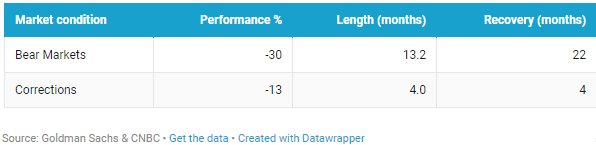
  • Since World War II, bear markets have lasted, on average, 13 months while stock markets tend to lose 30.4 percent of their value.
  • During those conditions it usually takes stocks an average 22 months to recover, according to analysis from Goldman Sachs and CNBC.
Polar Bear Rolls In The Snow On An Island In The Beaufort Sea On Alaskas Arctic Coast
Patrick Endres / Design Pics | First Light | Getty Images
It's helpful to know what a "bear market" is because based on history, it looks like we could be here for a while.
The term on Wall Street is synonymous with serious, long-lasting declines in stock markets. In numeric terms, a bear market is a 20 percent or more drop from a recent peak.
The S&P 500 hit that milestone on Monday, dropping 20 percentfrom its 52-week high. Markets have stumbled through what is usually one of their best months of the year, with indexes on track for their worst December performances since the Great Depressionin 1931.
Aside from a percentage drop, there other, more emotional ways to measure a bear market.
Pessimism tends to prevail. When good news isn't enough to hold off sellers and despite solid economic conditions, markets continue to tank — that's a bear market. The glass-half-full scenario is often overlooked and any positive news seems to be forgotten by the close of trading.
In December, oversold markets have struggled to make a comeback, suggesting that investors are worried about something bigger. Still, economic fundamentals are not giving red flags of a recession, which is usually a necessary condition for a full-fledged bear market.

When do stocks bounce back?

If this bear market is anything like the last time, it could take some time to recover.
Since World War II, bear markets on average have fallen 30.4 percent and have lasted 13 months, according to analysis at Goldman Sachs and CNBC. When that milestone has been hit, it took stocks an average of 21.9 months to recover.
Even when stocks enter "correction" territory, which is defined by at least a 10 percent drop from a recent high, there's a long road to recovery. History shows corrections last four months and equities slide 13 percent before finding a bottom.
Traders have a laundry list of things to watch heading into next year. The Federal Reserve is raising interest rates, making it more expensive to borrow money. Last week, the central bank hiked its benchmark interest for a fourth time this year while Fed Chairman Jerome Powell signaled it would continue to unwind its balance sheet at the current pace.
Investors are also focused on tense trade talks with China, a government shutdown that could last through the end of this week and oil prices.
-- CNBC's Michael Santoli contributed to this report.

Monday, 5 November 2018

Top Investment Blogs to Read

To become a top investor, you need to read as much as you can. I love to get into the minds of top investors by reading about their techniques, their experiences, and their knowledge.

1.

https://musingsjeffong.blogspot.com/

This blog is started by someone who knows property and stock investment well. His technique and philosophy is well thought out. He is adept in technical analysis, fundamental analysis, calling macros well. He is also very experienced in real estate investing. He also shares investment products like H2O Multibonds, which is a global macro fund that has achieved 17% IRR over seven years, with daily liquidity. He belongs to the community of people who contributed to articles in this blog.

2.

https://www.valuewalk.com/

Started in 2010, ValueWalk.com offers breaking financial industry news — with a focus on hedge funds, large asset managers, and value investing. The site provides quality content that is important to value investors (most of which is free).
It is read by senior level executives at the largest banks, hedge funds, asset managers, and Fortune 500 companies.
3.
https://thereformedbroker.com/
This blog was started in November 2008 by the New York City-based financial advisor and CEO of Ritholtz Wealth Management, Joshua M. Brown.

The blog covers markets, politics, economics, media, culture and finance. Brown uses “statistics, satire, anecdotes, pop culture references, sarcasm, fact, fantasy and any other device” to communicate his market-related insights.
Brown has been featured in or has written for Fortune, Forbes, the Wall Street Journal, MarketWatch, Dow Jones Newswires, Bloomberg, Reuters, and more. He is also an on-air contributor to CNBC.
4.
https://www.oaktreecapital.com/insights/howard-marks-memos
Oaktree Capital Management is a global alternative investment management firm with expertise in credit strategies. A section of their website is devoted to insights specifically from their internal team about investment strategies and investment philosophy. Howard Marks (CFA and Co-Chairman of Oaktree) covers topics from index investing to macro-fragility, to algorithmic investing.

Thursday, 23 August 2018

Longest Bull Run in History? What Comes Next...

Splashed all over investment sites and TV channels like Bloomberg and CNBC, headline news says, "bull run has reached its longest in history".

Nothing can be further from the truth. It is rather narrow minded to say that the bull run from 2009 1 March is in tact, when it only applies to the US.

Look at the S&P500 ETF. It is breaking a new high. In fact it is forming a double top. I expect a pull back from here due to record high valuation and technical resistance. However, if earnings are good, yield curve not inverted, the pull back can be shallow and resume its bull run.


What I cannot stand is this statement of a record long bull run only applies to the US. As if the US represents the world at large.

The Europe ETF is in bear territory, as is Asia ex Japan and Emerging Markets. In fact, between 2009 and now, Europe went through one bear market (defined by > 20% correction) between May 2011 and Feb 2013. Asia ex Japan and Emerging Markets suffered two bear markets between May 2011 and Feb 2013, and again between May 2015 and Feb 2016.


The US' longest bull run is punctuated by many bear markets in the rest of the world. The HSCEI has just fallen back to the 2015 low. Russia, Turkey too have fallen to its troubled lows of Feb 2016. There are plenty of opportunities outside of the US.

Prospects for US stocks in general for the next 10 years are extremely poor. I see a repeat of 2000 and 2007, where the S&P500 fluctuates around current levels.

I expect the Europe, EM, Asia x japan to bottom after the US Nov 18 mid term elections. The US president should be more dovish and tone down his trade tariff threats. I suspect in fact the three markets will bottom in Feb 2019. There could be yet another leg down to a lower level but not now.

A global recession could yet arrive but not till 2020 or 2021. We won't know. But the yield curve has yet to invert, economic growth is still strong in the US.

I'm beginning to suspect that politicians, central bankers control stock markets and property cycles by tweaking interest rates, lending policies, fiscal policies. The economic cycle takes a break when the Fed decides so.

My more extreme hypothesis is the US is the chief instigator of recoveries and crashes. The world watches the Fed closely. If the S&P 500 crashes, I've never seen other stock markets recover. If the S&P500 recovers, I've seen other stock markets crash, such as now. The world will take a while more to decouple from the US. Until we can have a second global currency, we are all hooked on USD as the world's reserve currency and hence at the mercy of the FED.

Saturday, 7 July 2018

Trend is Down But Rebound Coming

Several news that happened. In Singapore, the government implemented new cooling measures.

Generally, they increased the stamp duty by 5% across the board except for first time home buyers. For second homes, it has risen to over 10%. For foreigners, 25%! For residential properties held under companies, around 25%.

LTV also dropped by 5% even for first time home buyers. It is 75% for loans with tenors over 30 years. For companies, it is as Low as 20%.

You can’t make money betting against the government. David Tepper, the famous hedge fund manager, made a lot of money investing in the direction of the government. E.g. in 2009, he bought banks, casinos etc, corporate bonds.

The government wants people to deleverage, discourage investors from tinkering with residential properties. The message is, “if u wish to invest, buy stocks, bonds, or commercial properties.”

For stocks, I see a new Low across the board, but there is a huge rebound now. I don’t know if the trend has turned bullish but I’m still net short. 

Wednesday, 16 May 2018

Stabilisation of the Stock Markets

Europe appears to have broken the downtrend. But the upside might be limited in the short term. It will hit the resistance in Jan 2018. We shall see. I'm neutral for most markets. selective long in certain stocks and funds. shorting some ETFs. 

Friday, 30 March 2018

Signal For A Major Correction Triggered

I mentioned that the uptrend is in tact in my last article. What started as a 10% correction and a quick rebound has triggered a SELL signal for a BIG market correction. It will be as big as the ones seen in 2011, during the European Crisis and Japan Tsunami, and 2015, during the Emerging Markets meltdown and oil and gas implosion. The corrections during those periods were between 20 - 30% peak to trough. In some sectors, like the oil & gas, was -50%. It took around 1 year to recover the last high.

I don't think it will be like the BEAR markets of 2001, 2003 and 2008. The yield curve in the US did not invert this time so no recession is seen next year. In fact, the yield curve steepened. The pull backs are likely to be caused by high valuations of the tech sector, US and CORE Europe in general.

Looking at the MSCI World ETF, the current rebound is still well below the highs tested in Feb 18. Global equities are testing the 150 days exponential moving average in fact. It does not bode well and I would say there may be another 5% to 15% to go on the downside.


With that in mind I have started to short the European and US indices. I have sold those stocks that are well above 20% profit. It is better to hold cash than to hold on to stocks and watch your profits evaporate. I'm now only doing 13% per year return. That's 28% from Feb 16 to now. It's not a fantastic return at all but that is the weakness of momentum and value investing. You do very well when equity markets are on the start of a big jump. But at inflexion points, you do badly. I'm working to improve my system though by introducing counter-trend profit taking to complement momentum + value. This will prevent a lot of the drawdowns seen in momentum investing.

Sunday, 18 February 2018

After a 10% Correction, What Happens?

I started taking profit in January 18. The indices were just too far above the 50 day exponential moving averages. They had to snap back. I was however too gentle in my sales. My portfolio fell by around 8% before rebounding. I sold off some emerging markets, tech funds. Some HK shares and the China fund that rose over 50%.

Within 2 weeks global stocks snapped below the 50 DEMA. There was support at the 150 day EMA. I started to buy back at around 8% cheaper. The bull trend appears in tact, at least until second half of 2018.

https://finance.yahoo.com/news/p-500-price-forecast-february-063741440.html

As I look at the fundamentals, fewer indices appear within the BUY zone of above 8% annual return, based on the CAPE ratio. Russia, Turkey, Spain, Malaysia, BRazil, Australia and Poland are still in the BUY Zone. But Italy, Emerging Markets, UK have fallen out. China is well below the pecking order.

US stocks are still in the SELL zone as always. But Global Developed and Global equities are in the edge at around 4.1 and 4.3% return respectively. I think a further 10 - 15% return will see Global equities enter the SELL zone and we will probably see the another BIG correction. Hang on tight. 

Monday, 8 January 2018

Property vs Financial Investments

Five years into my property portfolio expansion, after reading the book that changed the way I viewed property, "3+1", I more or less decided which is better.

I'm 1.75 years into consistently producing profits in stocks, unit trusts, forex, commodities, even crypto currencies like Ethereum. It was down to technical analysis. I had no problems with fundamental analysis. I am a CFA after all. But technicals took a bit of learning for me.

I've achieved 22% IRR for stocks, 13% for unit trusts, 30% for forex and 40% for crypto. My property portfolio is roughly 35%. But cashflow wise my property ROE was poor, around 4%. Even if I manage my Birmingham and Manchester cashflow properties well, it will be around 15 - 17%. They are illiquid after all and don't allow fractional sale.

Refinancing of property is increasingly difficult. Between 2010 - 2015, real estate was definitely better. I could extract 125% of my initial equity, leaving my IRR over 100%! Nothing could beat that. In the last 2 years, refinancing to extract equity is almost impossible. I'm stuck in Australia, more or less have no equity to release in London, and don't exactly have a strong banker in other cities.

Financial investments definitely paid off better in the last 1.75 years. It is liquid. I could withdraw my profits easily. 20 - 25% IRR is definitely best I can do now.

But I've recently discovered a potential game changer for real estate that will allow me to extract my equity fully within 1 year and recycle it infinitely. That will be even more exciting! 

Saturday, 30 December 2017

Momentum Won the Day But Becomes Stale in 2018

Sticking With Winners Is What Won in 2017’s Stock Market https://www.bloomberg.com/news/articles/2017-12-29/momentum-stocks-stole-show-in-2017-with-whiff-of-dot-com-mania

There are two types of momentum: stale and fresh momentum.

Momentum in academia is defined as assets that rose or fell in the last 12 months. There is plenty of research that they tend to continue in the same direction in the subsequent 12 months. E.g. stocks that rose in the last 12 months tend to continue to rise in the next 12.

However, one must differentiate between fresh and stale.

Stale momentum is assets that prior to the 12 months, was rising in the last 12 months. That means from t-24 to r-13 assets were already rising.

Fresh momentum means prior to last 12 months, they were falling for previous 12 months. That means t-24 to t-13 they fell, t-12 to t-1 they rose.

Stale momentum assets tend to run out of steam after 4 months, if you count from March 2016 which was the start of the momentum, March 2017 to March 2018 is considered fresh momentum. But from March 2018 onwards, the odds of momentum continuing is poor after 4 months. Hence July 2018, we could see momentum failing. Hence it reinforces my view that we have entered a dangerous period in 2018 and we should see a major correction at least in the second half of 2018.

Stay tuned. Meanwhile, ride the trend.


Tuesday, 26 December 2017

Working Towards SGD10m Networth

Having counted what I've invested and what I'm worth, I realise that I'm slightly below 5m of networth. Cashflow wise, I'm producing a nice number that's probably less than 500k. But I had to work so hard for it.

In order to move towards the 10m mark I will have to accelerate my pursuits. The more cashflow generating businesses and assets I have, the better I will be. 

3m of net assets should generate roughly 150k of passive cashflow easily by right. If I work it right I should generate close to 250 - 300k of cashflow. 

If I hit around 5m of net assets I should have around 500k of cashflow. 

I have 2 properties that can potentially en bloc and harvest around 1.7m of equity. One of which is in Geylang which will probably happen in the next 5 years. The other one may take another 10 years. 

Nothing block busting is going to occur the next 5 years unless I embark on a wildly successful business.

I realised that my return on equity is only 3.6%. Real estate alone is not generating enough cashflow obviously. Several issues came up:

1. Apartments in Australia were a let down. They were bought off plan and between 15 - 30% more expensive than existing homes. Capital gains were obviously poor because I bought them more expensive.

2. Rental yields were barely higher than interest rates. I forgot that in overseas, mortgage rates were usually much higher than the LIBOR or cost of funds.

3. Body corporate, or service charges were usually double that of Singapore's, thereby wiping out any cashflow.

4. Generally, apartments other than those in London, where capital gains were fabulous, were a let down. Luckily we turned to houses which provided ROE of around 10 - 15%.

From now on, we had to go for projects with higher ROE than 4%. Our development project in London yielded 20%. 

Thursday, 2 November 2017

Speeding Up The Journey To Be Financially Free

In the last few months, I've completed another transaction. I now own over seven investment properties and one residential property. IRR is roughly 30% because of leverage and rental income. Every single property of mine yields higher than the borrowing cost. At least 75% of them produce positive cashflow after deducting all expenses.

My financial investments is doing around 22% IRR.

Yet, when I calculated my networth, it is still much lower than I had expected. I've started my investment journey in 2006 and intensified it in 2013 with a buy-hold-refinance-buy more strategy. Four years on from 2013, no doubt I've made over USD2m but it is still well below being financially free, cashflow still unable to replace my income. In other words, I'm still in the work force.

There are other ways to make it bigger:

1. invest in en bloc properties. You can earn over S$2m per property if you pick the right ones. But there's no guarantee that whatever you pick will be loved by developers or your neighbours will be willing sellers.

2. Strike lottery.

3. Run my own advisory firm. This is in the plans and it will be one big way for me to hit wealth much faster.

Don't get me wrong. Money is not everything. It allows me freedom to do charity. To help others. To help my family. This is the end goal.

Sunday, 13 August 2017

6到12个月的时间,可能看到一个陡峭的权益纠正,但我可能是错误的

自2000年以来,我们看到每两到三年的差距就在20-50%之间。

2000  -  2001年9月,50%修正(熊市)。
原因:以CAPE比率记录高股本估值。新兴股市上涨100%,科技泡沫。 9/11恐怖袭击

2002  -  2003年6月,MSCI世界(熊市)的30-40%改正。 SARS,企业渎职。冒牌开始牛市。

2007年11月 -  2009年2月,MSCI世界(熊市)修正约60%。大衰退次级崩溃从美国开始。美国的股票估值并不高于中位数。

2011年5月 -  2012年9月,修正约20%(大修正)。欧元区危机。海啸在日本。全球复苏缓慢

2014年11月 -  2016年8月,大约10%的修正(大修正)。新兴股票和商品受美国利率上涨的影响。


马克吐温说:“历史很少重复,它只是韵律”。

在2018年,我们应该看到至少20%的重大调整。即使中央银行准备重新降息。我们在恢复周期中非常迟。这就是为什么:

1.差不多十年的低利率和量化宽松政策导致了亚洲的债务泡沫。我们看到石油和天然气新加坡天然气行业慢慢陷入违约。中国的高企业债务和违约行为迄今已被政府席卷全地,但持续了多久?

2.发达国家的CAPE或周期性调整后的价格收益率的估值是自1929年刚刚大萧条之前和2000年以来科技泡沫高度的最高水平。

3.全球IPO的涨幅越来越大,表明公司认为估值接近高峰。公司倾向于上市,以退出公开市场。

大量的资金追逐昂贵的资产。我们看到私募股权基金,开发商投标资产的收益率非常低,为3  -  4%。一旦利率上升1%,这些项目立刻就没有意义。

以下是牛市可能持续一段时间的原因:

通货膨胀仍然是良性的。由于自动化,工资并没有快速上升,所以与2005年至07年不同,美国的工资增长率不会比3  -  4%。

在市场上仍然有很多的恐惧。分析师,CNBC和彭博社的谈话负责人正在宣扬公牛的结束。对公牛的结束表示太多的担忧。这必须是最讨厌的公牛。

新兴市场股票,如俄罗斯,土耳其和巴西,仍然远低于估值的中位数。预计它们每年的名义回报率将达到10%至16%之间,相比美国的2%,这相当令人印象深刻。

在这个周期的这一部分,我们做什么?

全球经济放缓(2002,2009-10),买入股票。他们是第一个恢复。买地用于未来发展。购买像建成建筑这样的硬资产,因为收益率高达9-15%。没有竞争对你的出价。购买商品买高收益债券。

全球经济下滑(2003年至04年,2011年至12月),出售一些股票,但并非全部,因为收益开始压缩,购买硬资产。随着地价的上涨,开始将土地发展成为建筑物。 2009年买入的开发商利润率最高。

全球经济复苏(2005年,2013  -  15年),停止购买硬资产,因为它们不够流动,不足以迅速退出。只购买具有重建潜力的物业。开始销售你的项目。保持你的商品。利率已经开始上涨,但持有你的高收益债券。

全球经济升温(2006  -  07年,2016年至18年)。开始出售一些非常低收益的硬资产,例如商店以3  -  4%的上限率。快速出售您的项目,如果不将其出租。出售股票等流动资产。仅投资于ETF,单位信托。任何液体的东西。不要坚持亚洲的非流动性高收益债券。

第一个迹象出现(2007年11月)。迅速卖出股票。你现在应该出售一半的硬资产,希望把所有的项目都卖掉。保持非常流动的债券和平衡的资金。替代品如CTA非常方便。您可以开始缩小股票ETF。开始销售商品。

全球经济放缓开始(2008年6月)。现金,投资级债券,CTA,短期股权。开始在街上寻找血液。机会加倍

6 to 12 Months' Time, May See A Steep Equity Correction, But I May Be Wrong

Since 2000, We see a steep correction every two to three years of between 20 - 50%.

2000 - 2001 Sep, 50% correction (Bear Market).
Cause: Record high equity valuations in terms of CAPE ratio. EM equities rallied 100%, tech bubble. 9/11 terrorist attack.

2002 - 2003 Jun, around 30 - 40% correction of MSCI World (Bear Market). SARS, corporate malfeasance. False start to the bull market.

2007 Nov - 2009 Feb, around 60% correction of MSCI World (Bear Market). Great Recession. Sub Prime meltdown started from the US. Equity valuations in the US were not extremely above median.

2011 May - 2012 Sep, around 20% correction (Big correction). Eurozone crisis. Tsunami in Japan. Slow global recovery.

2014 Nov - 2016 Aug, around 10% correction (big correction). EM equities and commodities hit by rising US interest rates.

"History Seldom Repeats, It Merely Rhymes", so says Mark Twain.

We should see a major correction of at least 20% in 2018. Even with Central Banks ready to go back to rate cutting mode. We are extremely late in the recovery cycle. Here's why:

1. Almost a decade of low rates and quantitative easing have resulted in pockets of debt bubble in Asia. We are seeing oil & gas sector in Singapore slowly going into defaults. High corporate debt and defaults in China has so far been swept under the carpet by the government but for how long?

2. Valuations in terms of CAPE or cyclically adjusted price earnings ratio in the developed world is at the highest since 1929 just before the Great Depression and 2000, the height of the tech bubble.

3. IPOs are at an increasing rate worldwide, indicating that companies feel that valuations are near peak. Companies tend to IPO to exit into public markets.

4. Lots of money chasing after expensive assets. We see private equity funds, developers bidding for assets at very low earnings yields of 3 - 4%. As soon as interest rates rise another 1%, the projects immediately do not make sense.

Here are the reasons why the bull markets may last a while longer:

1. Inflation is still benign. Due to automation, wages are not rising as fast, so we don't see 3 - 4% wage growth in the US, unlike in 2005 - 07.

2. Still a lot of fear in the markets. Analysts, talking heads of CNBC and Bloomberg are touting the end of the bull run. There is far too much worries to signal the end of the bull. This must be the most hated bull run ever.

3. Emerging market equities, such as Russia, Turkey and Brazil are still well below median in valuations. They are projected to produce between 10 and 16% return per annum nominal, which is quite impressive, compared to the US' 2%.

In this part of the cycle, what do we do?

Global economy slowing down (2002, 2009 - 10), buy stocks. They are the first to recover. Buy land for future development. buy hard assets like completed buildings because yields are super high at 9 - 15%. No competition for your bids. Buy commodities. Buy high yield bonds.

Global economy hits trough (2003 - 04, 2011 - 12), sell some stocks but not all, buy hard assets as yields start to compress. Start to develop your land into buildings as land prices rise. Profit margins for developers who bought in 2009 is at the highest.

Global economy recovers (2005, 2013 - 15), stop buying hard assets because they are not liquid enough to exit quickly. Buy only properties with redevelopment potential. Start selling your projects. Keep your commodities. Interest rates have started to rise but hold on to your high yield bonds.

Global economy heats up (2006 - 07, 2016 - 18). Start to sell some hard assets that have very low yields, e.g. shops at 3 - 4% cap rates. Sell your projects quickly, if not rent them out. Sell some liquid assets like stocks. Invest only in ETFs, unit trusts. Anything that's liquid. Do not hold on to illiquid high yield bonds in Asia.

First signs of trouble emerges (2007 Nov). Sell of equities quickly. You should have sold half your hard assets and hopeful sold all your projects by now. Keep very liquid with bond and balanced funds. Alternatives like CTA come in very handy. You may start to short equity ETFs. Start selling commodities.

Global slowdown starts (2008 Jun). Cash, investment grade bonds, CTAs, short equity. Start looking for blood on the streets. Opportunities galore.